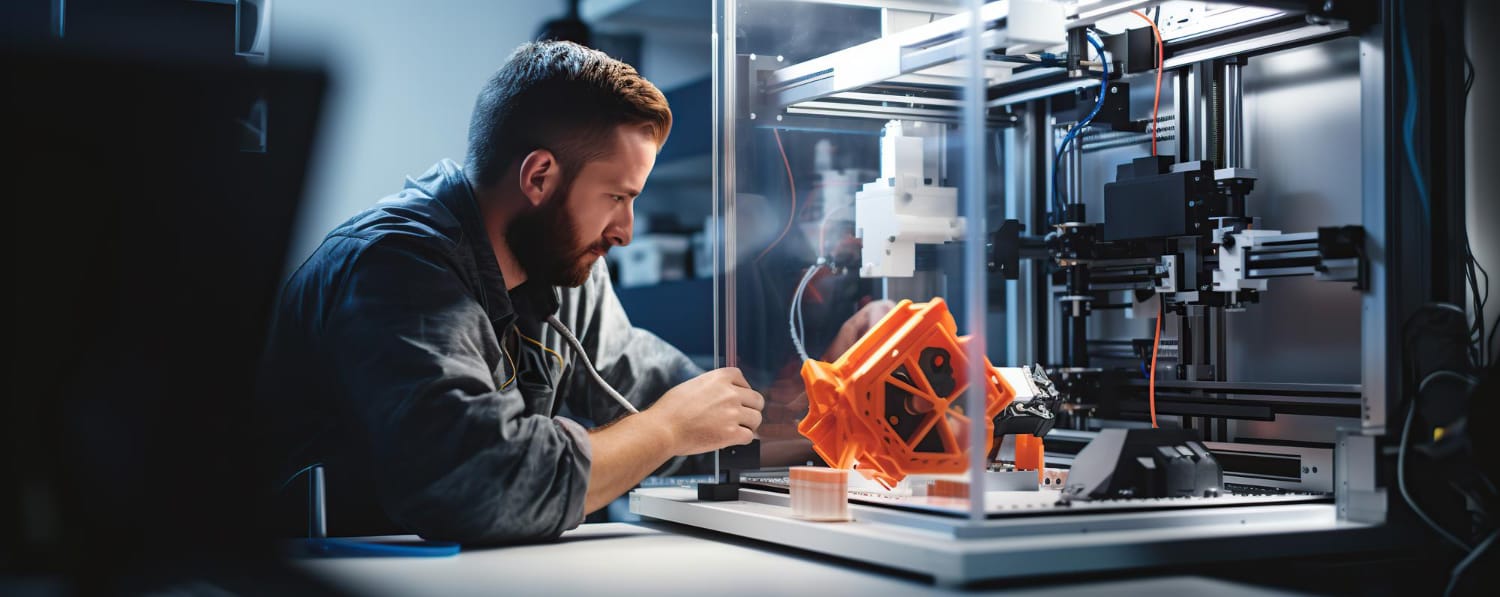
Additive Manufacturing (AM), also known as 3D is significantly impacting new product development by enabling faster prototyping, design freedom, and customization. It allows for the creation of complex geometries, rapid iteration of designs, and cost-effective production of customized products, particularly in low-volume, high-value scenarios.
Here’s how AM is transforming product development:
- Accelerated Prototyping and Design Iteration:
- AM allows for the quick and relatively inexpensive production of multiple prototypes, enabling engineers to test and refine designs rapidly.
- Digital modifications to designs can be made easily, reducing costs associated with design changes compared to traditional methods.
- This iterative approach allows for faster identification and resolution of design flaws before mass production.
- Design Freedom and Complex Geometries:
- AM breaks free from the limitations of traditional manufacturing processes, allowing for the creation of highly intricate and complex part designs.
- Products with complex geometries, lattice structures, and internal features that were previously impossible to manufacture can now be readily produced using AM.
- Customization and Personalization:
- AM excels in producing customized products tailored to specific customer needs or applications.
- This is particularly beneficial in the healthcare industry, where patient-specific implants and devices can be manufactured using AM.
- Similarly, in the automotive and aerospace industries, AM enables the production of customized parts for specialized applications.
- Cost and Time Efficiency:
- While AM may not be cost-effective for mass production of simple parts, it offers significant advantages for low-volume, high-value items.
- The elimination of tooling and setup costs associated with traditional manufacturing methods can lead to substantial cost savings, especially for customized products or specialized components.
- The ability to produce parts on-demand reduces lead times and inventory costs.
- Applications Across Industries:
- Aerospace: Lightweight parts with complex geometries like turbine blades and fuel nozzles.
- Automotive: Prototyping, tooling, and low-volume production of specialized parts.
- Healthcare: Patient-specific medical devices, implants, and surgical planning tools.
- Architecture and Construction: Complex building components.
- Design for Additive Manufacturing (DfAM):
- DfAM is crucial for fully leveraging the potential of AM.
- It involves designing parts specifically for the additive manufacturing process, taking into account its unique capabilities and limitations.
- Challenges and Future Outlook:
- While AM has seen significant advancements, it still faces challenges related to material limitations, build speed, and process control.
- Continued research and development are crucial for expanding the capabilities of AM and addressing these challenges.
In conclusion, AM is revolutionizing product development by enabling faster prototyping, greater design freedom, customization, and cost-effective production of specialized parts. By embracing AM and DfAM principles, companies can unlock new possibilities for innovation and create products that were previously impossible to manufacture.



 Innov Touch Technologies Pvt Ltd.